
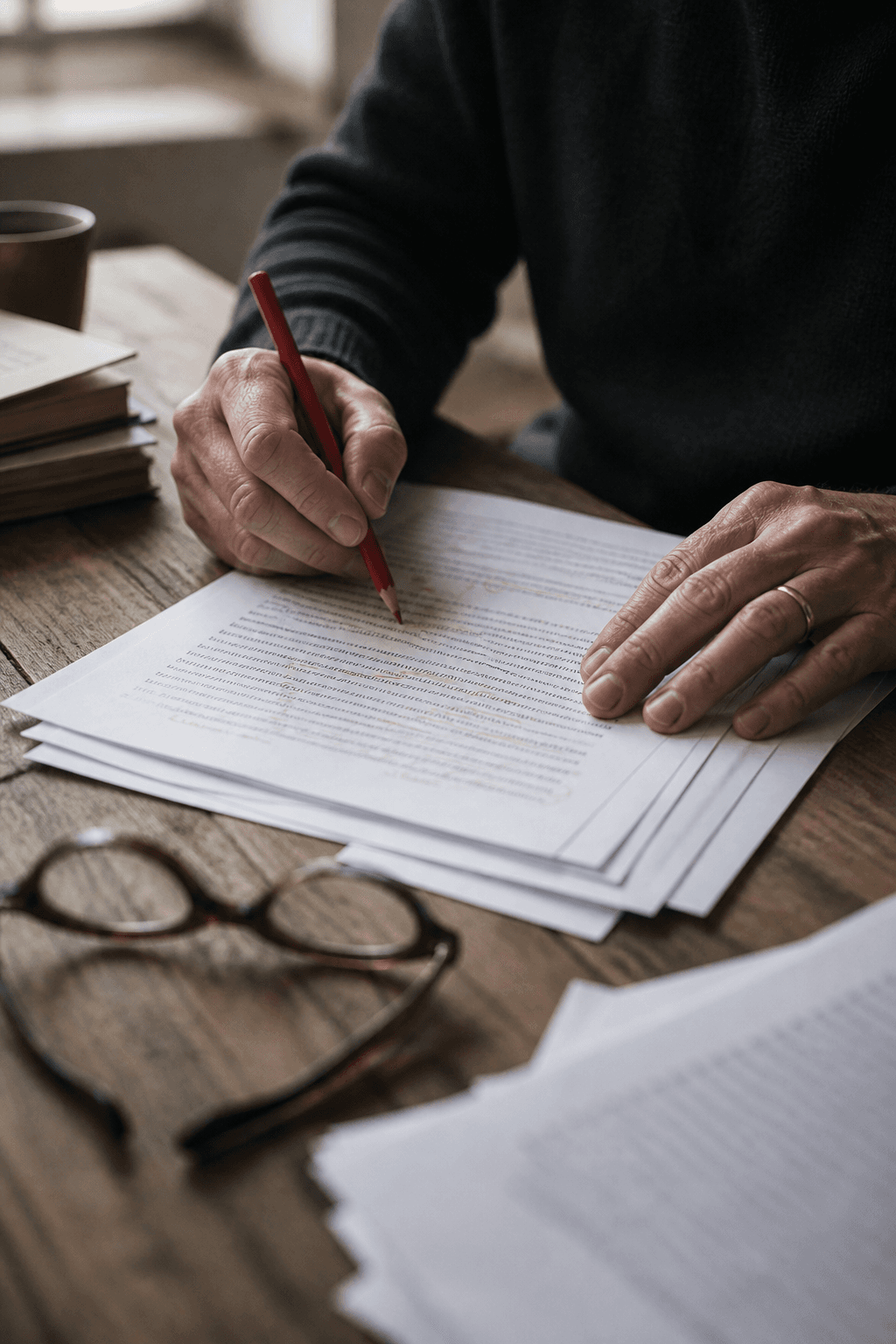
How Editors Can Vet a Freelance Submission Without Accusing Anyone
A submission can fail three different ways: generated filler, borrowed passages, and invented facts. Here is how to check all three, and how to raise what you find with a writer.
Every editor who commissions outside work develops the same instinct. Two paragraphs into a draft, something feels off, even though the sentences are clean and the structure holds together. It just doesn't seem to know anything. For years the only response was reading closer and hoping you caught it.
That instinct still matters more than any tool. But it helps to know exactly what you're catching. A submission can fail three separate ways, and only one of them involves AI.
Three different failures
Generated filler performs competence without delivering it. It hits the word count, covers the outline, and somehow says nothing a reader couldn't have guessed on their own. An AI-detection check is built for exactly this, and a sentence-level report does more work than a single overall score, because it points to which specific passages need a cut or a query.
Borrowed passages are the older problem, and honestly the more dangerous one. A plagiarism check returns matched sources with the overlapping text highlighted, so a vague suspicion turns into something you can act on, or if it comes to that, show a lawyer.
Invented facts are the newest failure mode, and the one most likely to survive a copy edit. A language model will produce a confident statistic, a plausible attribution, a study that flat out doesn't exist, writing all three in the exact register of a well-sourced sentence. A fact check works claim by claim. It labels each one supported, partially supported, unverifiable, or refuted. That catches what a normal edit pass misses.
Running all three on the same draft
There's no reason to run three separate tools one at a time. Run the AI-detection check first, then add the plagiarism and fact checks against that same piece. Detection takes up to 150,000 characters, which covers almost any article-length draft you'll ever see. Plagiarism allows 120,000. Fact-checking caps out far lower, at 10,000, because it's pulling and verifying individual claims instead of scanning a whole document.
If a piece runs longer than the fact-check limit, run it on the sections carrying the load-bearing claims. That's usually a small slice of the total word count anyway.
The harder part is raising it with the writer
This is exactly where most editors get stuck, and understandably, since nobody enjoys accusing someone on thin evidence. An accusation built on a percentage is both unpleasant and weak, and if you're wrong, you've damaged a relationship over a number neither of you actually understands.
A few things actually help here.
Talk about passages, not scores. "These three paragraphs read generic to me, can you tighten them with something specific" is an editorial note. "Your piece scored 87% AI" is an accusation, and a fragile one at that.
Lead with the fact checks. An unsupported claim is a problem no matter how it got there. It's a far easier conversation than authorship, and it usually surfaces the same underlying issue anyway.
Share the actual report. Every saved report has a read-only link, so the writer sees exactly what you saw instead of taking your summary on faith.
Know your own policy before you open the tool. Plenty of publications now permit AI assistance with disclosure. If you haven't decided where your own line sits, a detector isn't going to decide it for you, and enforcing an unwritten rule after the fact isn't a fight worth picking.
What a detector is actually for here
It's a triage tool. It tells you which of forty submissions earns the careful read, and which three paragraphs inside that submission earn it. On a job that's mostly triage, that's real time saved.
What a detector can't do is settle a writer's integrity. Detection is probabilistic, false positives are well documented, and clean professional prose gets flagged more often than most editors expect. Treat a result as a place to look, not a conclusion to defend.
Want to try it on something already in your queue? The AI detector for editors page runs a free check with no account needed. The plagiarism checker and fact checker run against the same text.