
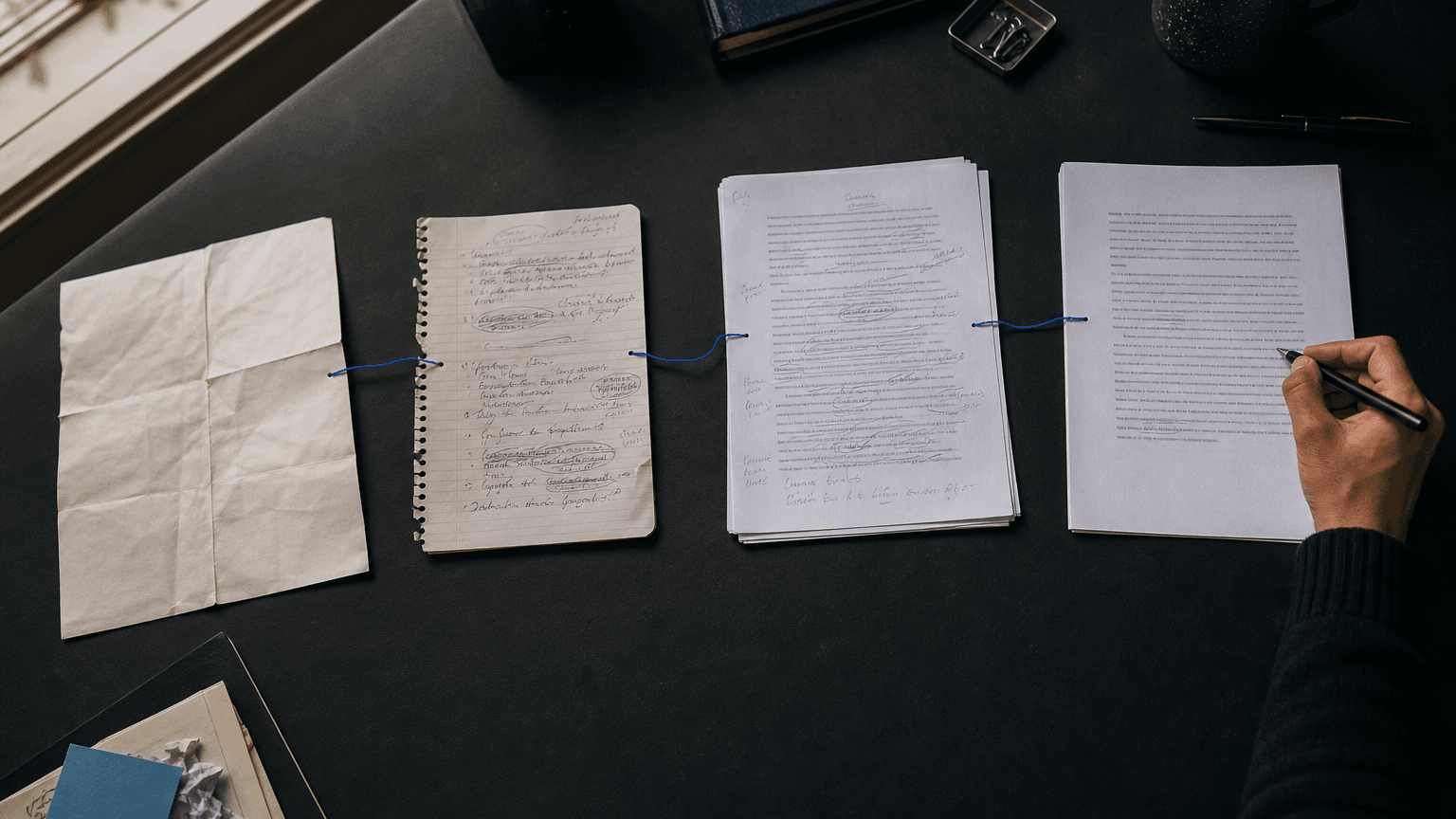
A detection score is not proof you wrote something. Your process is.
That gap matters a lot more now than it did two years ago. 74% of college faculty say students are using AI to write essays and papers, and clients read that headline too. So does every agency lead who has ever had to explain a missed deadline. The instinct that follows is almost always the same, and it's almost always wrong. High score, guilty writer.
Arguing with someone's AI detector rarely goes anywhere, because you are disputing a number and they are trusting a number. What actually moves the conversation is a short, organized record of how the piece got made. The brief. Then the messy first pass. Somewhere in there, the edit where you cut the paragraph that wasn't earning its place. Build that record before you need it, not after.
What a score cannot see
A detector looks at finished prose. Burstiness, sentence rhythm, vocabulary patterns, how predictable the structure is. What it cannot see is you rejecting the client's first pitch at 9:14 in the morning, or moving a statistic three paragraphs down because it didn't survive a fact-check, or cutting four hundred words because your conclusion was going in circles.
That missing context is the whole case against treating a score as a verdict.
No detector, ours included, should be read that way. Short passages trigger constantly. Clean, well-edited writing can look eerily like AI output, and the people who get hit hardest by that are often non-native English writers, whose careful and formal phrasing gets misread as generated text. A detection score is a reason to look closer. It is not evidence that a person used AI, and treating it as evidence anyway is how you end up accusing your best writer.
The investigation belongs somewhere else entirely, in provenance, the record of where the work came from and how it changed along the way.
This got messier in August 2026, when Anthropic started embedding an invisible watermark in everything Claude writes. If you asked Claude to tighten a paragraph you wrote yourself, that paragraph can now carry a machine-readable mark while every idea in it stayed yours the whole time. The mark records that a model touched the text somewhere. It has nothing to say about who did the thinking, which is exactly why the record below still matters more than the mark does.
For a writer, that record can be the assignment brief or the client Slack thread, dated research notes, an outline with the abandoned ideas still visible, version history, tracked edits and comments, or the invoices and delivery emails around the project. An agency might have a contractor's source notes and the point where an editor changed a headline. For a student, it could be handwritten planning, library search history, or the ability to explain why one source got used over another.
The final document is the last artifact in a chain. A credible authorship record shows the chain before it, not just the ending.
Save the ugly middle
Most people start preserving evidence only after they've been accused, which means reconstructing a process from browser history and half-memory. That is a bad way to spend an afternoon.
Build a workflow that leaves useful residue on its own, before there's a reason to need it.
Google Docs, Word, Notion, Obsidian, a folder of plain Markdown files. Any of them work. What matters is whether the tool captures four real stages, from the input (brief, prompt, interview notes) through the thinking (sources, outline, the claims you rejected), the drafting (versions that actually show the piece changing), and finally the review (comments, edits, the final approval).
Do not manufacture a dozen tiny edits to make a document look more human after the fact. That's theater, and it reads as theater to anyone who's seen it before. Write the way you normally write, because the normal record is the one actually worth keeping.
Say a content marketer is writing a 1,200-word comparison page. A reasonable trail looks like brief-v1.md, a research sheet with six competitor URLs and pricing notes, an outline dated the day it was made, a first draft with the weak section still sitting in it, editor feedback asking for a clearer objection, and the final CMS version. That's enough to explain the work. The weak section is actually useful evidence. Real drafts have detours in them, and a draft with no detours at all is the one that looks staged.
The same logic holds if you used permitted AI assistance for brainstorming or a grammar pass. Keep the prompt. Keep the output if it changed anything real. Mark what you kept and what you threw out. Authorship doesn't require pretending that tools like this don't exist in the first place, only that you're specific about what they actually did.
A packet beats a screen recording
When a client or instructor questions a document, dumping your whole Drive on them just creates more work and more suspicion. Send a compact packet instead, built for three to five minutes of someone else's time.
The original brief shows you understood the assignment before you started, and one page or a couple of messages is plenty. A research trail of five or ten sources shows your facts came from somewhere identifiable. Version history, ideally a shareable link rather than a folder of screenshots, shows the document actually grew over time. A short change summary, four to six lines, shows you can explain the big decisions. The final draft puts the disputed work back in its context.
Then write one plain note. Not a legal brief:
I wrote this from the attached brief and source set. The version history shows the outline, the first draft, then the fact-check edits and a final pass on top of those. I've included a summary of the major changes and I'm happy to walk through any paragraph or source decision.
That last line is doing the real work. A person who wrote something can usually explain why paragraph seven exists, why a claim got softened, or why one source beat another one that said almost the same thing. Someone who pasted the output might answer fine on the surface, but the answers tend to stop being specific pretty quickly.
Students should be ready to talk about why the thesis shifted, what source changed their mind, and why they picked one quote over another that fit almost as well. Freelancers should be ready to talk about audience, the conversion goal, what got cut from scope, and the tradeoffs an editor pushed back on. If a client wanted a calm comparison page instead of a hard sell, say that plainly. It's craft evidence, and it's also just true.
Don't write for the detector
This is where people go wrong in the opposite direction.
Writers start dropping in awkward fragments, swapping ordinary words for stranger ones, making a clean draft worse because a tool told them it "reads AI." That trade is backwards, plain and simple. Your reader gets weaker writing and you still haven't proven anything about who wrote it.
A University of Chicago audit from 2025 tested four detectors against a corpus of nearly two thousand passages, covering news, blogs, reviews, novels, restaurant write-ups, and résumés. Results varied sharply by tool and by threshold. The open-source baseline misclassified real human writing as AI in anywhere from 30% to 78% of cases depending on where you set the dial. Every detector isn't useless because of that spread. But a detector's score depends on a policy choice about which kind of mistake its operator would rather make.
Turn the threshold down and you catch more real AI text, along with more human text that just happens to read cleanly. Turn it up and false positives shrink while some real AI slips through, and nothing makes that trade disappear entirely, ours included.
So skip the bad advice that's floating around. Planting errors on purpose to look human doesn't help anyone. Neither does rewriting a clean sentence purely because a score dislikes it, treating a low score as proof of anything, or leading with a screenshot as your only defense. Fix a sentence because it's genuinely stale, not because a tool objected to it. "This comprehensive solution provides a seamless experience" deserves to be cut on editorial grounds alone, independent of what any detector thinks of it. A good writing tool should point you at patterns worth a second look. It shouldn't train you to write badly on purpose.
Make it part of delivery, not a panic response
There's a genuinely practical reason this matters even outside of school, past any classroom. AI use at work is uneven, not universal, whatever the headlines imply. A nationally representative NORC survey from 2025 found 15% of employed Americans use AI at work daily, and 58% said they never use it at all. That gap is exactly the tension writers are already living with. Teams write policy as if AI use were universal, while actual workflows vary enormously from person to person.
That's the case for building a clean authorship habit before anyone asks for one.
Freelancers can add one line to a proposal, something like "drafts are delivered with source notes and revision history on request." It signals professionalism instead of making the relationship about suspicion from day one. Agencies should ask contractors for the editable working file, not only a final export, and keep review comments attached until QA closes, so a later question has an answer already sitting there. Students should check the course policy before opening any AI tool at all, and document briefly if brainstorming help is allowed. If it isn't, don't gamble on "just one prompt" being invisible. Editors get the most out of asking a writer to explain their sourcing before running a detector, because that conversation resolves more than a percentage ever does.
The best time to prove your work is while you're doing it. Do that, and an audit trail is just what delivery looks like afterward, almost for free.
Specific evidence is checkable evidence
A version history with four hundred meaningless saves is weak. A blank document created three weeks ago is weak. Ten screenshots of a cursor moving around a page prove nothing to anyone.
Evidence gets persuasive when someone else can check a few concrete links in the chain themselves. Suppose an editor questions a product review, and your packet says the brief arrived July 8, you interviewed the customer success lead on July 10, the pricing claim came from a vendor page saved July 11, the comparison table changed after legal asked for softer wording on July 12, and the final draft was approved July 15. Now the reviewer has something to check. They don't need to trust your confidence, or your detection score, because the dates and the artifacts are sitting right there.
This is also why unsupported claims quietly and reliably sink authorship disputes before they even get started. A draft with real sources, correct citations, and visible fact-checking defends itself. One full of smooth generalities doesn't, no matter how confidently it was written. Substance leaves a trail behind it. Vagueness doesn't.
Did AI Write It keeps two separate questions apart on purpose: which sentences triggered a score, and what the document's actual history shows. Sentence flags give you somewhere to look. Version history and a real diff give you something better than a guess, a record of how the text actually changed, in the order it changed.
That's the standard worth holding yourself to, especially when the stakes are somebody else's trust in you.
Build the record before someone asks for it
A false positive feels personal because the accusation is personal, but the response doesn't have to match that energy.
Keep the brief and save the notes as you go. Draft somewhere with real revision history. Hold onto the edits and source decisions that actually mattered, and if you used AI within whatever rules applied, say so plainly instead of betting on a score to cover for you.
Then, when someone flags the work, you're not stuck trying to prove you're human by arguing about a percentage.
Run a draft through Did AI Write It sentence by sentence, see what actually triggered the result, and keep a timestamped version history as you go. The goal was never to win an argument with a detector. It's to be able to show the work, because you actually did it.