
Claude Watermarks Your Client Work Now. What Do You Tell the Client?
If you use Claude to polish work you deliver to clients, that work now carries a machine-readable mark. Here is how to handle disclosure before it turns into an argument.
Here is a situation plenty of freelancers walked into this month without noticing.
You write a 1,500-word piece for a client. It is yours. You did the interviews, you built the argument, you cut the section that was not working. Before sending it over you paste the draft into Claude and ask it to tighten a few flabby paragraphs and fix the rhythm in the intro. Normal editing, the kind of thing you would have asked a colleague to do back in 2019.
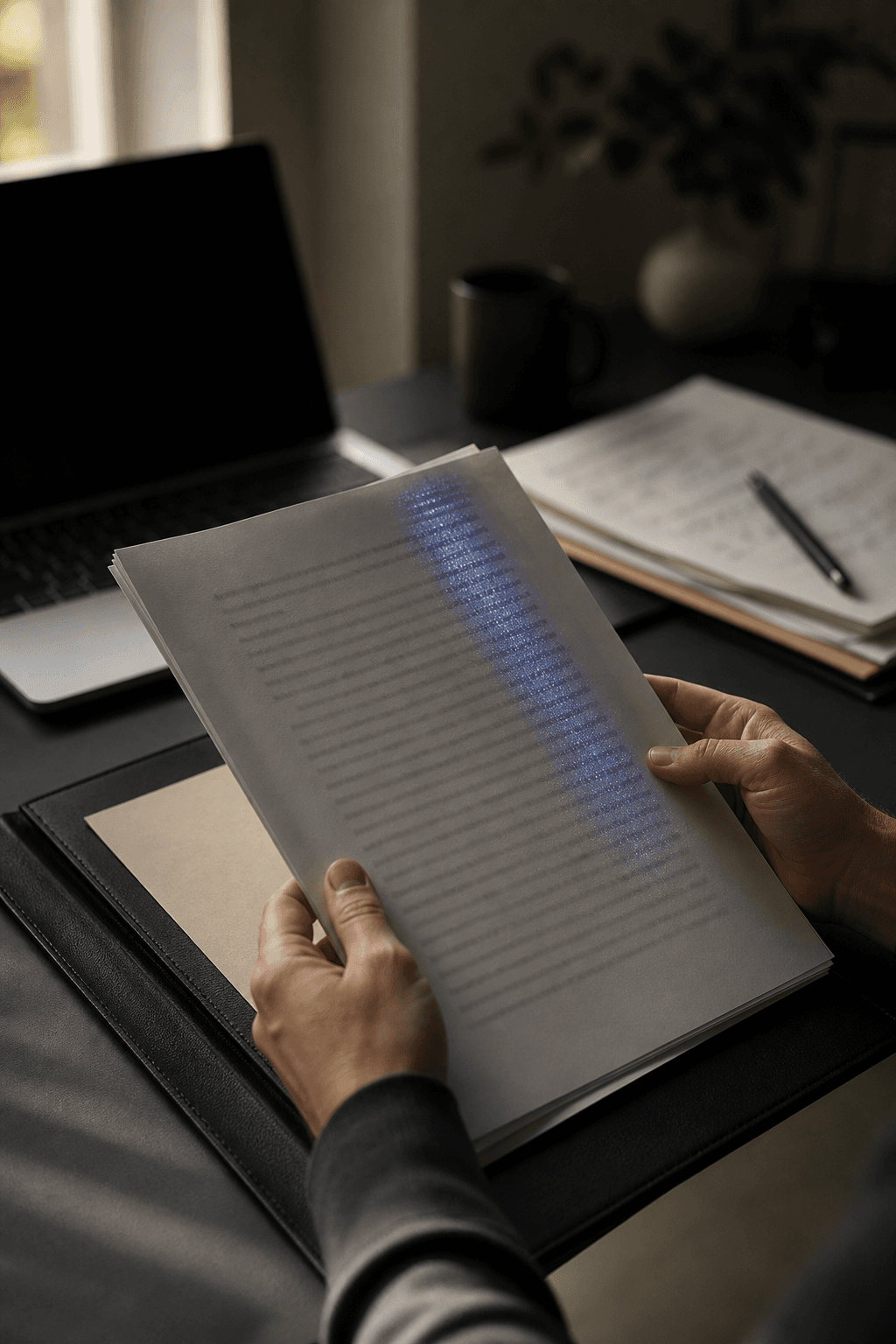
As of August 2026, the sentences Claude touched carry an invisible watermark. Your client can eventually run that file through a checker and find it, and the checker will report something narrow and technical that most people are going to read as "an AI wrote this."
That gap is the real problem here, not the watermark itself.
What actually changed
On August 11, 2026, Anthropic confirmed that Claude embeds a machine-readable mark in the text it generates. It happens inside the model as it picks words, so the coverage is total. Chat apps, the API, coding tools, and Claude running on any of the big cloud platforms all produce marked output. There is no published way to switch it off, and that includes paid plans.
The mark survives copy and paste, because it lives in the word choices themselves and not in file metadata anybody could strip out. Light editing usually leaves it readable. Heavy rewriting or translation will weaken it, and short passages never carry enough signal to check at all.
I wrote a fuller breakdown of what the mark proves and what it cannot, but the one-line version matters here. It records that a model processed some words. It has no idea who came up with the ideas.
One more thing worth knowing. Nobody can read the mark yet. Anthropic has said it will publish a way to check and has not done it, so this is a problem arriving on a delay, which is unusually generous as these things go. You have time to get out ahead of it.
Your client's AI clause just got teeth
Most content contracts written in the last two years have a sentence about AI buried in them. Something along the lines of "Contractor warrants that all deliverables are original human-authored work." Plenty of writers signed that while using ChatGPT as a grammar checker, reasoning that a grammar checker is not authorship.
A fair enough read at the time, and one nobody ever tested, because until now nothing could test it.
I am not going to tell you the clause means what your client thinks it means, because it usually does not, and a mark on a sentence you wrote yourself is genuinely weak evidence of anything at all. What you want to avoid is having that argument for the first time after a client has run a check and drafted an angry email. Winning it costs you the relationship anyway.
So have that conversation early, while nobody involved is upset about anything yet.
Put it in the proposal, not the apology
The cleanest fix is a line in your proposal or statement of work, agreed before you start. Keep it plain:
I use AI tools for editing passes on drafts I have already written, including grammar and rhythm. They are not used to generate drafts or to do research. Deliverables may carry a provider watermark as a result of that editing. Source notes and full revision history available on request.
That is not a confession. It is a scope note, and it reads like professionalism because that is what it is. Clients who care will tell you their policy. Clients who do not care will skim past it, which is fine, because the point was that you told them.
Two things make this work better than it looks. It converts a future accusation into a past agreement, which changes who is on the back foot. And the closing sentence quietly sets the standard you want any argument judged by, which is the record of how the work got made and not a signal buried in the finished file.
If a client's policy genuinely prohibits any AI involvement at all, you now know that before you have written a word, and you can decide whether to take the job or change how you work on it. Much better position than finding out in month four.
None of this is legal advice, obviously, and content contracts vary more than people expect. Where a client agreement has real money or real liability attached, have somebody who does this for a living read the thing.
If you run an agency, this is a supplier problem
Agencies get the harder version, because you are exposed from both directions. Your contractors deliver to you, you deliver to the client, and the client's policy is the one that binds everybody.
A few things worth doing now.
Ask your contractors what they use, in writing, once. Not as an accusation, and not as a form somebody has to file every quarter. One honest answer on file beats a policy nobody reads. You will find that most of them use something, most use it for editing, and a few will tell you they generate first drafts, which is the actual thing you needed to find out.
Require the working file and not just a final export. A Google Doc with revision history attached settles the authorship question in about ninety seconds. A polished PDF settles nothing, and a PDF is exactly what you get when you forget to ask.
Then work out your own position before a client asks, because eventually one will. "Our writers use AI tools for editing, and every deliverable goes through a named human editor who takes responsibility for it" is defensible, and most clients accept it. Silence is not defensible, and improvising an answer live on a call tends to go badly.
The European wrinkle nobody has explained to freelancers
If your client publishes into the EU there is a second rule in play, and it does not land on you.
The EU AI Act's transparency rules took effect on August 2, 2026. One of them says anyone publishing AI-generated text meant to inform the public on matters of public interest has to disclose that the text is AI-generated. That obligation sits with the publisher.
It arrives with an exemption worth committing to memory. The disclosure requirement falls away when content has had substantive human review and a named person or company takes editorial responsibility for publishing it. Rubber-stamping an approval does not count for this, and the guidance says so directly. Real editing by a real person does.
Read that twice if you write for anyone publishing into Europe. The regulation is not asking whether a machine was involved somewhere in the process. It asks whether a human took responsibility for the result. Those are different questions, and the second one is what your process should be built to answer.
So the agency that can show a genuine editorial pass by a named editor ends up in better shape than the agency that can show a clean detector score. That ordering is going to surprise a lot of people this year.
What not to do
Do not try to strip the mark.
Set aside whether it even works, which is doubtful for anything short of a full rewrite. The bigger issue is what you would be doing. You would be deliberately defeating a transparency measure on work you are about to invoice a client for, and if that ever surfaces it stops being a disagreement about tooling.
Do not rewrite good sentences into worse ones to dodge a check either. This is the same trap detectors created years ago, and it produces prose that is measurably harder to read while proving nothing whatsoever about who wrote it. Your client is paying for the writing.
And do not claim you did not use it. The version of this that gets people in trouble is "I barely used it," which is almost never true and falls apart under one follow-up question. "I used it for an editing pass on section three" holds up fine, because it is checkable and boring and real.
The thing that actually protects you
The record.
Keep the brief. Keep research notes with dates attached. Draft somewhere that has version history, and save the outline with the abandoned idea still sitting in it. When a client asks what happened, you send four things and a short paragraph, and the whole conversation is over inside ten minutes.
That record was always the real answer to "did you write this." The watermark changed nothing about that. It added one more signal for people to misread, and gave you a reason to build the record before somebody comes asking for it.
You can scan a draft and keep a version history as you revise here. The score is not really the point. Knowing what a reviewer will see before they see it, that is the point.